Live product
Lemat
Lemat by A'emro
A restaurant management and digital restaurant platform spanning guest-facing menus and operational workflows.
Product engineer — architecture through production
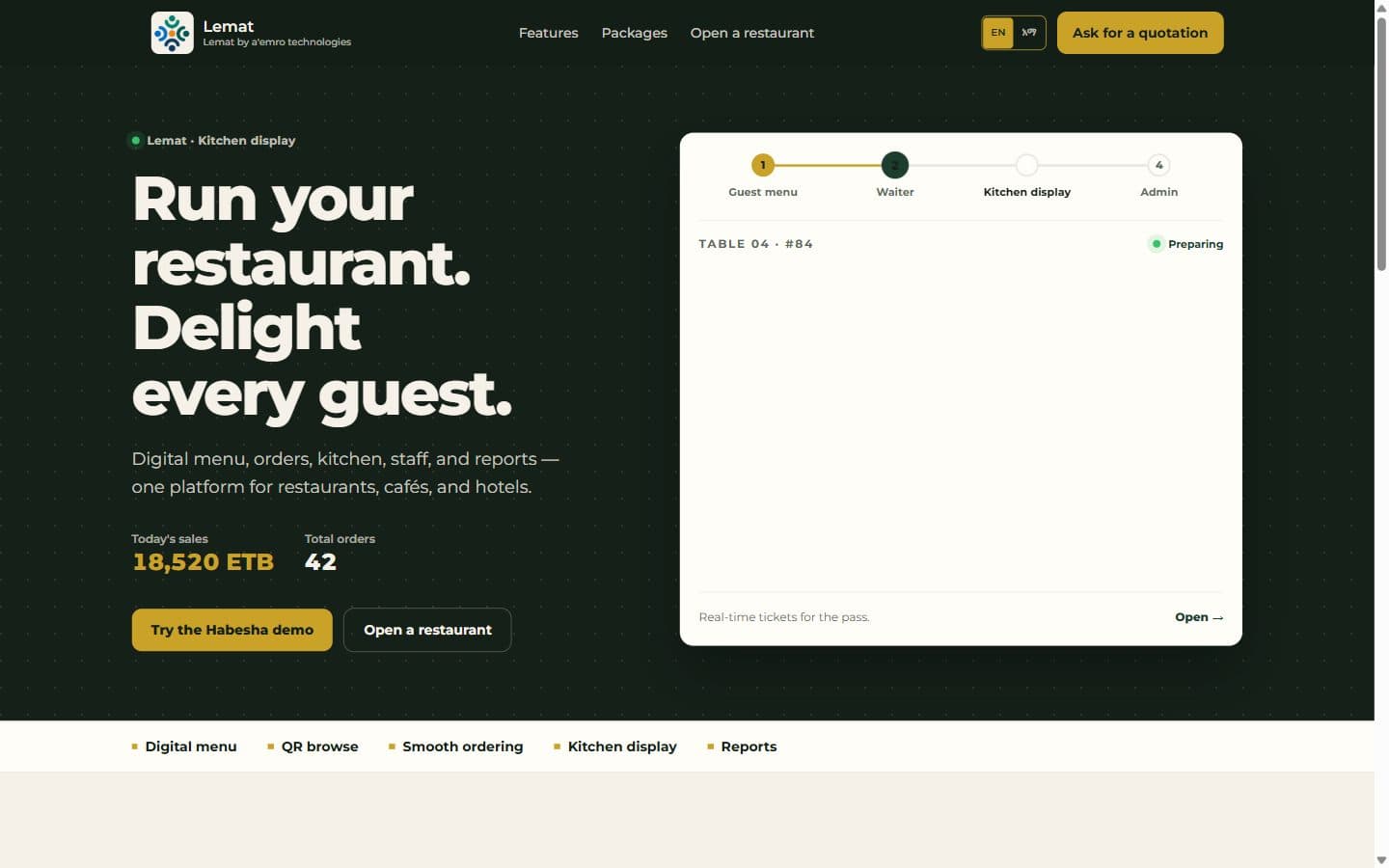
Product overview
Restaurants need a reliable way to publish menus, take orders in context, and coordinate staff without stitching together unrelated tools. Lemat is structured as a multi-module product: a guest experience on one side, and restaurant operations on the other, sharing a common domain.
Problem
Independent restaurants often run on paper menus, ad-hoc communication, and disconnected admin tools. That makes menu updates slow, staff workflows inconsistent, and operational data hard to use.
My role
Product engineer — architecture through production.
What I built
- Defined the product architecture as a multi-module platform rather than a single-purpose menu page.
- Designed and built the guest-facing digital menu experience, including QR-based access for dine-in use.
- Shaped restaurant administration around roles, so access and workflows can differ by responsibility.
- Mapped kitchen and waiter flows into the same domain model as the guest menu, so the product can grow without a rewrite.
- Owned the path from architecture to a public product at lemat.aemrotech.com.
Architecture
Client apps
Digital menu · QR guest experience · Restaurant admin · Staff workflows
API layer
REST APIs · Authentication · Role-aware authorization
Business services
Menu · Operations · Roles · Analytics
Data & integrations
Application database · External integrations
Key engineering challenges
- Keeping one domain model coherent across guest, admin, and staff surfaces.
- Designing role-based access that matches real restaurant responsibilities instead of generic CRUD permissions.
- Structuring modules so the platform can add operational capability without breaking the guest experience.
Technology stack
- React
- Next.js
- TypeScript
- Node.js
- REST APIs
Product modules
In the product
- Digital menu. Guest-facing menu experience for browsing restaurant offerings.
- QR-based menu access. Table or venue QR entry into the digital menu.
In the architecture
- Restaurant administration. Back-office control for menu and restaurant configuration.
- Role-based access. Permission model aligned to restaurant roles.
- Kitchen workflows. Operational surface for kitchen coordination.
- Waiter workflows. Floor operations for waiting staff.
- Analytics. Operational visibility across menu and restaurant activity.
Engineering decisions
- Treat the restaurant as the tenant and the menu, orders, and roles as shared domain concepts.
- Separate guest and staff clients while keeping a single API and business-service layer underneath.
- Expose only verified live surfaces publicly; keep remaining modules in the architecture until they ship.